
Launching your beauty brand may feel "impossibly" expensive unless you've heard of the private label cosmetics model. With this model, you don't need to set up a factory, hire experts, and chase certifications for compliance. A private label manufacturer produces your beauty brands. It lets you focus entirely on the sales and marketing part. This way, it saves you money, hassles and complications. But that doesn't mean you pick the one from those online searches and get started with them. It is important to learn the "ins and outs" of this model. Also, you need to find the right private label cosmetic manufacturer in India who can fulfil your needs.
This guide covers what private label manufacturing means. It walks through the process, from concept to delivery. It covers the licences you'll need, where India's manufacturing hubs sit, and what to check before you sign with a supplier.
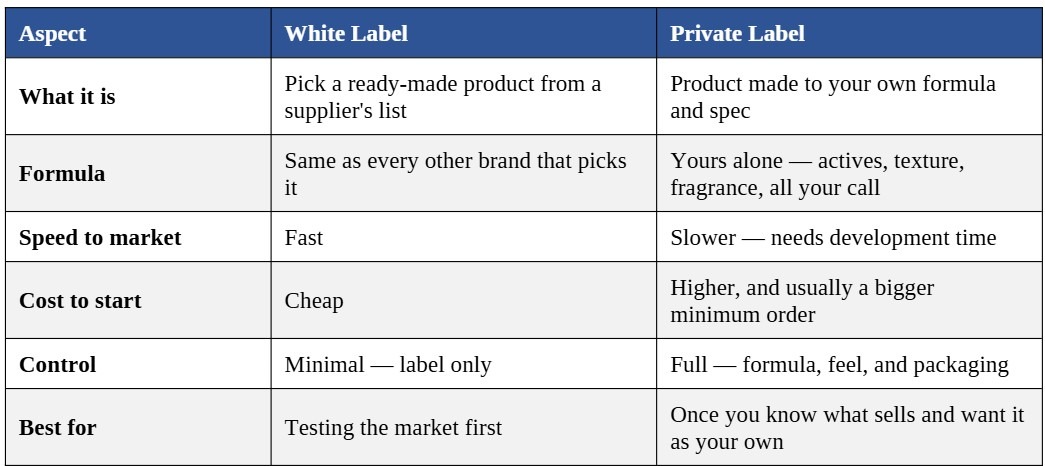
Private label cosmetics are made by a third-party supplier. They're sold under your brand name. The supplier handles the formula, the batch runs, and the tests. You handle the branding, the marketing, and the sales. However, it should not be confused with white label manufacturing.
White label means picking a product from a supplier's list. You put your own label on it. It's fast and cheap. But you're using the same formula as every other brand that picked that product too.
Private label, on the other hand, gives you more control. You can get the products made to your formula. In the private label model, you can choose specific active ingredients, change texture and viscosity, and pick natural fragrances or oil blends. You can even get your packaging designed.
Of course, it takes more time. It often needs a bigger minimum order. But the end product is truly yours.
Owning a cosmetics manufacturing in India can cost crores. Machines, licences, staff, and test labs all add up fast to that cost. And that's before you sell a single bottle of oil or moisturiser.
But that's not the case with private labelling. Private labelling skips nearly all of that. This is because you hire a contract manufacturer to get your products made. You only pay for the manufacturing. As a result, you skip the plant costs completely. No factory rent. No machine upkeep. No staff on your payroll. Your money goes into your product and its pack instead. You launch faster too.
A supplier with ready base formulas can send you a sample in weeks. Building your own R&D from scratch takes months, or years. And since you're not running a factory floor, you can spend your time elsewhere. Put it into content, influencer deals, pack design, and how you treat your customers. That's what actually builds a brand.
A good private label cosmetic manufacturer in India covers nearly every category a beauty brand might want to launch.
This is where most brands start. Niacinamide, hyaluronic acid, and Vitamin C serums lead the pack. Barrier creams, sunscreens, and face washes follow close behind, made for Indian heat and skin tones.
There is a huge demand for sulphate-free shampoos, scalp serums, hair growth oils, and bond-repair masks. Scalp health has also become a top buyer concern, so ask about scalp-specific serums too.
The cosmetics market is driven by truly wide shade ranges, lipsticks, eyeliners, and tinted lip oils. This range needs tight shade match from batch to batch. Ask any supplier about their shade-matching process before you commit.
The past few years have seen the rise of Ayurvedic and herbal beauty products.
Here is how you can work with any private label cosmetic manufacturer in India.
Before you pick anyone, decide who you're selling to. Work out what actives your product needs. Set your price point. A brand targeting premium Gen Z buyers needs a different formula, pack, and margin than one going after mass-market shelves.
Your supplier will offer you a choice. Pick from their base formulas, or ask for custom R&D. Base formulas are cheaper and quicker. Custom R&D costs more and takes longer, but gives you a formula no one else can sell. Either way, test the feel, the soak-in, and the scent first. Approve nothing until all three feel right.
Your pack is more than just a sense of aesthetics. This shapes shelf life, ease of use, and how premium your product feels in someone's hand. Airless pumps mean actives like Vitamin C are protected from light and air. Glass bottles may look luxurious, but they add weight to the product and can break during shipping. A protective, sustainable green pack is the new standard.
With your sample approval, the supplier goes to full scale. This means your product, like any other, goes through the shelf test. This tests the product's strength and holds up throughout shelf exposure to light and heat. A fit test checks that the formula won't react with its own pack.
Every batch goes through checks before it leaves the plant. Verify what gets checked - pH, thickness, germ count, weight. Ask how batches go out too, and how they reach your warehouse or fulfilment partner.
Make sure your private label cosmetic manufacturer in India has the certifications and permits to manufacture cosmetics. Cosmetics in India are governed by Cosmetic Rules, 2020, plus the Drugs and Cosmetics Act.
This is the licence to make the product. The third-party supplier holds it, not your brand. Before you sign a deal, ask to see the supplier's current Form 32. Check if it covers your product type.
You get a license (Form 32-A / COS-9) in your company's name. This lets you use the manufacturer's factory, workers, and machines to make your specific products. Or your supplier makes the product under their own licenses, and they simply put "marketed by: your brand name" details on the product label. It means that you don't need that permit.
The Central Drugs Standard Control Organisation sets safe limits for ingredients, banned lists, and test rules. The Bureau of Indian Standards adds its own quality marks for some ranges. A supplier who can walk you through both, without pausing, is one worth trusting.
Indian law is particular about what must be mentioned on your pack: ingredients in order of amount, MRP, make and expiry dates, net volume, and batch number.
There are some hotbeds of Indian manufacturing in India. Each has its own strengths.
How to choose a good private label cosmetic manufacturer in India? It is really important to pick the right one.
Early-stage startups can look for a partner that has small-batch flexibility such as minimum order quantities (MOQs) of 500-1,000 units per variant. Big, established facilities often need 5,000 to 10,000 units per run.
Make sure that the facility has cosmetic formulation chemists who work full-time. Ask them about custom R&D capabilities, ability to tweak texture or fragrance, and reverse engineer market benchmarks.
The speed to market is a huge competitive advantage. Ask about the exact timeframes for the following three important stages: sample turnaround time (ideally 7-10 days), first commercial production run (typically 30-45 days after packaging arrival), and re-order lead times (ideally 15-20 days).
Break the quote down line-by-line. A professional partner shall be clearly distinguishable:
Botanium Beauty Care, located in Mohali, is the private label cosmetics manufacturer in India you are looking for. We offer quality services at reasonable prices with certified plants and experienced staff and assure timely delivery.
We offer complete services - right from creating a formulation to packaging. If you are interested in developing your beauty brand with us, contact us now at +91-9855500409 or +91-9988500409.
While India has a booming cosmetic market, private label cosmetics manufacturing is the fastest yet profitable route to tap into the industry. However, there are so many things to consider while opting for private label cosmetics manufacturing. Choose the ingredients according to your target consumers and get involved at every step.

Trusted Derma Cosmetic Brand in 🇮🇳