
With third-party cosmetic manufacturers, you don't need to set up a factory. The manufacturer takes care of the manufacturing and testing. You just need to provide them with the formulation and the packaging design. In this guide, you will learn:
Things to look for, Whether you're launching your first face wash or growing a hair care range, you'll find real answers here. Let's get started!
Also known as contract manufacturing, third-party cosmetic manufacturing is a simple business model.
A beauty brand hires an outside factory to make its products. The factory has its own R&D team, raw materials, and licenses. They manufacture your beauty products and label them. This way, you get a market-ready product when you work with third-party cosmetic manufacturers.
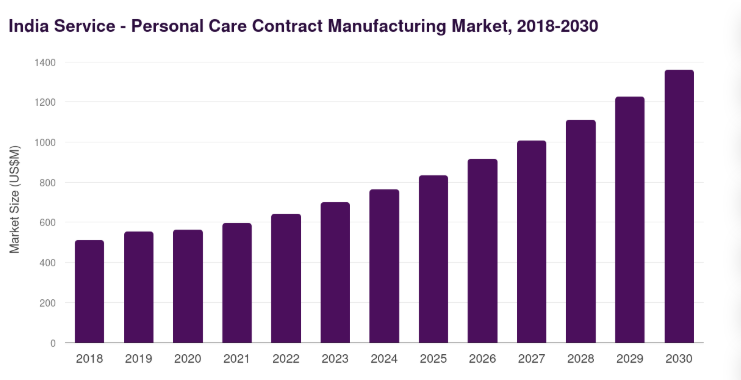
According to one industry study, there are nearly 700 contract manufacturers for the beauty and personal care industry in India. Grand View Research speculates that the personal care contract manufacturing is likely to reach USD 1.4 billion by 2030. It also finds that India "accounted for 3.4% of the global personal care contract manufacturing market in 2024."
For the Asia Pacific region, the nation is "likely to register 10% of the personal care contract manufacturing market."
Third-party manufacturing should not be confused with private label manufacturing. The two aren't quite the same.
Private label manufacturing means you pick a formula that already exists in the manufacturer's catalogue. You put your brand name on it and sell it as your own. It's quick and cheap. But other brands working with that same manufacturer can use the same formula too.
Third-party manufacturing goes further. You can ask for a custom formula built to your exact needs. You can request changes to fragrance, texture, or active ingredients. The manufacturer makes it just for you, under a signed contract. It costs more and takes longer. But you end up with a product nobody else is selling.
| Feature | Private Label Manufacturing | Third Party Manufacturing |
|---|---|---|
| Formula | Ready-made, shared with other brands | Custom-built or exclusive to your brand |
| Speed to market | Very fast | Moderate, depends on formulation stage |
| Investment | Lower | Moderate to higher |
| Product uniqueness | Limited | High |
| Ideal for | Testing an idea quickly, small budgets | Building a distinct, long-term brand |
| Packaging | Often standard options | Fully customisable |
Neither option is wrong. It comes down to whether you want to launch fast and test the market, or build something that's truly yours from day one.
A cosmetic manufacturer can build products using your unique formulation. Or they let you choose from their wide range of ready formulations. So, which one is right?
This table can help you.
| Feature | Ready Formula | Custom Formulation |
|---|---|---|
| Development time | None, ready to produce | Several weeks to months |
| Cost | Lower | Higher |
| Exclusivity | Shared with other brands | Exclusive to your brand |
| Flexibility | Limited changes possible | Fully tailored to your specs |
| Best for | Quick launches, tight budgets | Long-term brand building |
| R&D involvement | Minimal | Extensive |
If you want to test whether a category will sell before you invest heavily, a ready formula gets you to market fast. If you already know your audience and want something that stands apart, custom cosmetic formulation is worth the extra time and cost.
The process is more structured than most first-time founders expect. Here's how a typical project moves from idea to delivery.
You decide what to make - a face serum, a shampoo, a body lotion. Once you are done with that, you share your requirements with the manufacturer. This covers the category, your target price point, and any ingredients or claims you want on the label.
Once the manufacturer gets your requirements, their R&D team picks a suitable base formula. Or they can build a new one from scratch. As we said, this depends on whether you've chosen private label or custom formulation. Expect a few rounds of feedback on texture, fragrance, and active concentration.
The manufacturer sends you a sample to test. This is your chance to check the texture, smell, colour, and performance before you commit to a bulk order. Most brands ask for two or three rounds of changes here.
You choose bottles, jars, tubes, or sachets from the manufacturer's stock options. Or you bring your own custom design. Some manufacturers also help you source packaging if you don't have a vendor.
Your brand's label goes through design and approval. This covers all the details Indian cosmetic labelling rules require. That means ingredient lists, the licence number, and batch details.
Once everything is signed off, the manufacturer runs your batch on their production line. They follow the approved formula and quantities you agreed on.
It is important to check those products for quality. Quality checks, stability testing and microbial testing are usually performed by the manufacturer. They will also provide a Certificate of Analysis, or COA, for each batch.
Finished, labelled and boxed products are packed and shipped to your warehouse or fulfilment partner. They are ready to be sold.
You skip the cost of machinery, factory rent, and a full-time production team. Your money goes into product development and marketing instead.
A new brand can go from idea to shelf in a few weeks with private label options. Custom formulations take a few months. But building your own factory takes years.
A reputed cosmetic manufacturing company has WHO-GMP certified facilities. Your products are made to a recognised quality standard, without you having to build that setup yourself.
You get chemists who've already solved problems you haven't even thought of yet. They've seen stability issues, preserving problems, and texture troubles before. You don't need to hire your own chemist.
When your product sells well, the manufacturer scales up the batch size. You don't need new machinery or extra staff to meet demand.
A good third-party cosmetic manufacturing company keeps up with labelling rules, ingredient limits, and licensing requirements.
Someone else makes the product, but you own the brand. You own the formula too, in custom arrangements.
No factory overheads. No production staff payroll. No equipment to maintain. All these responsibilities are handled by your third-party cosmetic manufacturing company.
Your fixed costs stay low while your business grows.
Most cosmetic third-party manufacturing companies in India cover a wide catalogue. Here's what usually falls under three broad categories.
If you're planning a full range and not just one product, ask your third-party cosmetic manufacturing company upfront if they cover all three categories. It saves you from juggling multiple vendors. It also keeps your quality consistent across the range.
Not every third-party cosmetic manufacturing company suits every brand. Here's what actually matters when you compare options.
Before production starts, most third-party cosmetic manufacturers will ask you for:
A third-party skincare manufacturer will start working once you've filed your trademark, even before it's fully registered. Check their policy early, so it doesn't delay your launch.
Here's the flow from concept to dispatch, in order:
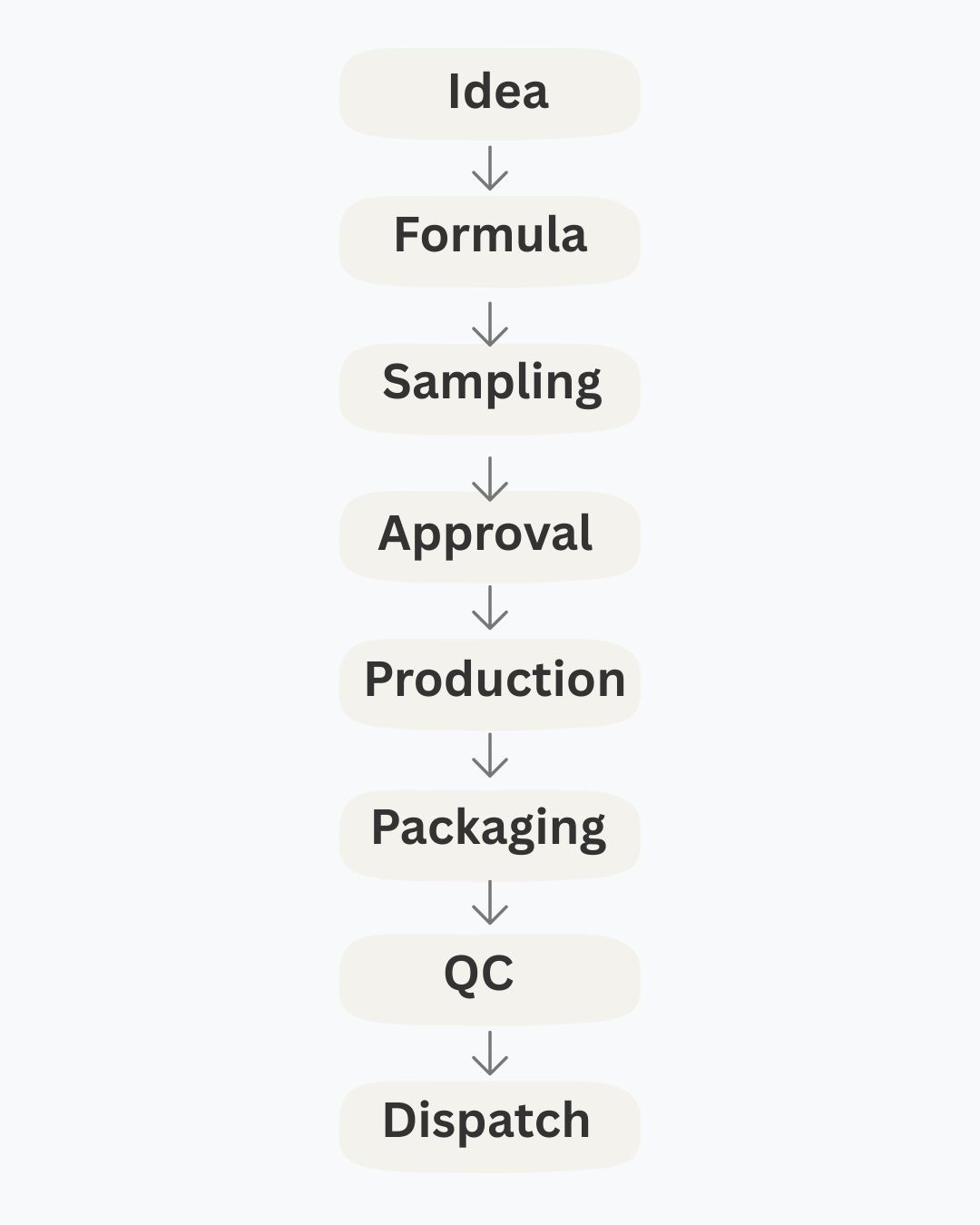
Each stage has a checkpoint before the next starts. A rushed manufacturer who skips sampling or approval is a red flag, not a time-saver.
Ask for these documents. A factory that follows the rules will share these papers without any hesitation.
Prices vary too much between manufacturers, product types, and order sizes. Here are the factors that actually move the price:
Ask for a detailed quote broken down by these items, not one lump figure. It makes it much easier to see where you can adjust to fit your budget.
This is just an estimate as the prices may vary based on the manufacturers you choose.
| Product Category | Typical Specs | Per-Unit Cost Range (INR) |
|---|---|---|
| Basic Soaps & Cleansing Bars | 75g-100g standard base | Rs.20 - Rs.45 |
| Face Washes & Cleansers | 100 ml plastic tube / bottle | Rs.35 - Rs.80 |
| Shampoos, Conditioners & Body Washes | 200 ml PET bottle with flip-cap | Rs.40 - Rs.90 |
| Moisturizing Creams & Lotions | 100g - 200g plastic jar or pump | Rs.50 - Rs.120 |
| Specialized Facial Serums | 30 ml glass dropper bottle (e.g., Vitamin C, Niacinamide) | Rs.90 - Rs.220 |
| Essential Oils & Hair Serums | 30 ml - 50 ml glass/PET bottle | Rs.60 - Rs.140 |
| Sunscreens (Broad Spectrum/Gel) | 50g - 100g specialized tube | Rs.80 - Rs.180 |
MOQ exists for a simple reason. Manufacturers need a batch size big enough to justify running their machinery and staff for that cycle. Small batches just aren't cost-effective for either side.
Typical MOQs for cosmetic products in India vary a lot. Simpler private label items might need only a few hundred units. Some manufacturers may need you to order at least 500 units, or some have set their minimum order to 1000 units. Custom formulations with special packaging often need a few thousand.
If the standard MOQ feels too high, you can negotiate with the manufacturer. Many manufacturers offer a lower MOQ for your first order, so you can test the market. Repeat orders then meet the standard limit.
The lowest quote often means a cosmetic products manufacturer is cutting corners on raw materials or testing. Therefore, focus on the value rather than solely on the price.
GMP certification, ISO 22716, and country-specific registration requirements aren't paperwork to sort out after launch. In India, cosmetic manufacturing needs a licence under the Drugs and Cosmetics Rules, and every formulation has to meet BIS standards before it goes anywhere near a shelf.
Packaging is what protects the formula from air, light, and contamination. It is also the first thing a customer sees. A pump that clogs, a jar that lets in moisture or a tube that cracks in transit ruin the product's reputation.
Brands often launch first and think about trademarks later. Then they find someone else already owns a similar name. Or their manufacturer has quietly claimed rights to a name used during development.
Cutting corners on actives or preservatives impacts performance and shelf life. Ask for certificates of analysis on the key ingredients, not just a list of names. Ask where the raw materials come from. Ask if they test each batch that comes in, or just trust the supplier's word.
A product can look perfect on day one and fall apart by month three. It might separate. It might change colour. It might lose strength. Stability testing checks how your formula holds up over time, in heat and light, before it reaches a single customer.
Ordering far more than you can sell ties up your cash. Even worse, it can lead to expired stock. Always choose a low MOQ cosmetic manufacturer.
A manufacturer who can't handle a bigger order later means you have to switch vendors in the middle. Switching manufacturers at that phase means retesting your formula, renegotiating your contract, and risking gaps in supply right when demand is highest.
India's role in global cosmetic manufacturing is only increasing. Here are a few reasons why.
Many Indian cosmetic manufacturers have a team of experienced chemists, quality staff and production workers.
Cosmetics made in the Indian manufacturing units are exported to the Middle East, Africa, and Southeast Asia.
Over time, India's cosmetic regulations have been evolving with state licenses and central guidelines.
Making cosmetics in India costs less than in the US, UK, or most of Europe. It is quite affordable to find a workforce here. Plus, many raw materials come from local sources too. That cuts import costs.
However, lower cost doesn't mean lower quality. Many Indian factories now match global standards. They just charge much less than Western rivals.
States like Himachal Pradesh, Uttarakhand and Gujarat house plenty of WHO-GMP and ISO certified plants. Brands now have more robust, compliant factories to select from.
Indian manufacturers don't just copy Western formulas anymore. Many now run their own research. For example, they have started using natural and Ayurvedic ingredients. Turmeric, neem, and other herbs get a modern twist through new science. These products sell well both in India and abroad.
Over the years, Botanium has established itself as a quality skincare brand trusted by thousands of customers across the country. We also offer third-party cosmetic manufacturing services.
Here are some key reasons to work with us.
If you want to learn more about our third-party cosmetic manufacturing services, please reach out to us at +91-9855500409 or +91-9988500409. Or you can visit our Mohali office located HERE.
Choosing the right Third Party Cosmetic Manufacturing Company shapes everything about your brand. It determines the quality your customers experience and how fast you can scale. Take the time to check certifications, ask questions, and start with an order size that lets you test the relationship first. Get that foundation right, and third-party cosmetic manufacturing becomes one of the smartest ways to build a beauty brand in India today.

Trusted Derma Cosmetic Brand in 🇮🇳